

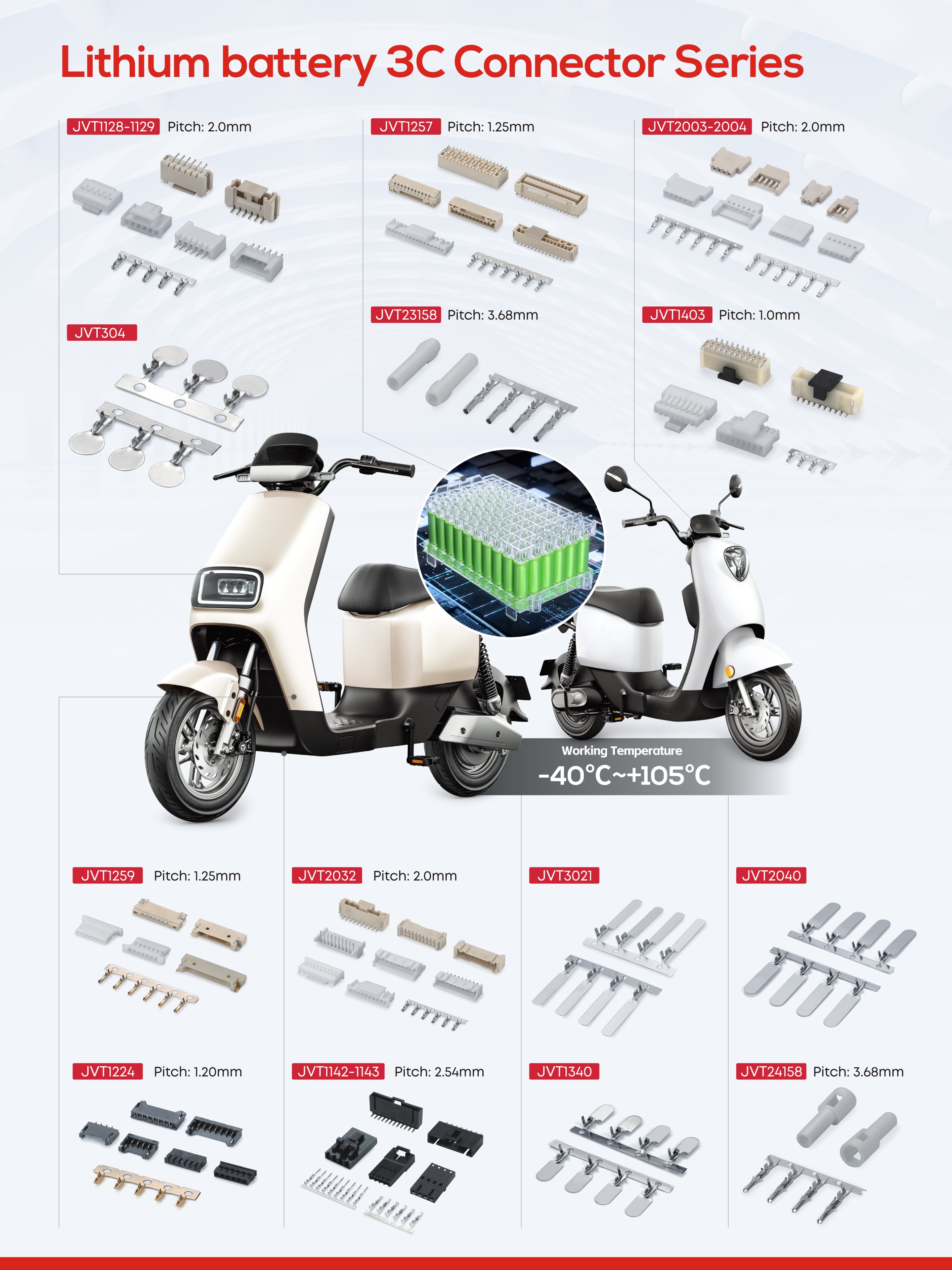
An e-bike connector sits in a hostile place for a consumer product. It lives inside a frame tube that collects water, it shares the harness with a motor controller that switches hard, and it is serviced by a technician in a shop or by a rider with a toolkit rather than on a production line. On an electric two-wheeler program covering the instrument cluster, lighting, and battery harness, the customer's assembly data showed that most wiring defects appeared at the harness junctions rather than at the boards, and the brief to us was to simplify those junctions without moving to automotive prices.
This case study explains what a two-wheeler harness actually has to survive, how a cost-appropriate substitution can still be robust, and what the program reported. It is written for engineers and buyers specifying connections for e-bikes, e-scooters, and light electric vehicles.
What an E-bike Connector Faces Between Frame and Street
The environment on a light electric vehicle is closer to a motorcycle than to a consumer appliance, and the harness carries a mixture of power and signal that makes each junction do several jobs.
- Water and condensation inside the frame. Frames are not sealed structures. Water enters through cable ports, and inside a metal tube it condenses whenever the temperature falls. Connections that sit in the frame see moisture on a regular basis.
- Continuous vibration from the road. Road surfaces deliver a wide spectrum, from the high frequency buzz of a rough surface to the low frequency movement of a pothole. The harness and its junctions absorb all of it.
- Battery current alongside signal wiring. The battery feed and the motor phase wiring run in the same bundle as the instrument and lighting signals, so the harness is an interference problem as well as a mechanical one.
- Repair in the field. Two-wheelers are repaired by shops with limited diagnostic equipment, so a connection has to be easy to inspect and easy to replace without special tooling.
None of those is as extreme as the automotive equivalent, and that is the opportunity. A two-wheeler does not need a fully automotive sealed connector with an automotive price, provided the interface is designed for the exposure it actually sees.
How We Simplified the Harness Junctions
The starting point was a harness with many small terminations distributed through the frame. Each one was a possible fault, and each one had to be crimped and plugged during assembly.
Consolidate the signal junctions
We moved the instrument and lighting wiring onto multi-position wire-to-wire interfaces, so a junction that used to be several individual connections became a single keyed pair. That change removed both a failure point and an assembly step, and it made the harness easier to route through the frame.
Keep the battery path separate and properly rated
The battery interface stayed on its own family, sized for the discharge current rather than merged with the control wiring. Separating power and signal across different connectors also reduces the interference that the motor controller would otherwise couple into the instrument signals.
Retention and keying for field service
Every junction supplied for this program uses a latch and a keyed housing. On a two-wheeler that is repaired in a shop, keying prevents the mistake that costs the most time: a pair pushed together the wrong way round, producing a fault that looks like a failed component.
Interface configuration for this program
Signal junctions: multi-position wire-to-wire pairs for the instrument cluster and lighting circuits, keyed and latched.
Battery path: a separate interface sized for the discharge current, kept apart from the control wiring.
Environment: inside frame tubes with condensation and road splash, continuous road vibration, and shop level service.
Positioning: an economical substitution for imported automotive grade parts where the full automotive specification is not required.
What the Program Reported
The outcomes below are the ones reported for this two-wheeler program. They describe this harness design and this vehicle platform.
| Item | Previous harness | Simplified junctions |
|---|---|---|
| Junctions in the harness | Many small individual terminations | Fewer consolidated multi-position pairs |
| Assembly defects found at harness junctions | The main source of wiring faults | Reduced by removing junctions rather than by inspecting them |
| Signal integrity | Instrument and motor wiring shared a bundle | Power and signal separated onto different interfaces |
| Field repair | Individual wires to identify | Keyed pairs that cannot be mated incorrectly |
| Cost position | Imported automotive grade parts | Specified for the actual exposure rather than the automotive worst case |
The customer's conclusion was that the harness had been over specified in the wrong direction: expensive where it did not matter and fragile where it did. Consolidating the junctions and separating power from signal addressed both ends of that problem at once.
Choosing the Right Level of Specification
Light electric vehicles sit between consumer electronics and automotive products, and the specification should reflect that position rather than defaulting to one end. A fully automotive sealed interface brings cost, bulk, and connector size that a bicycle frame does not need. A consumer grade interface brings a failure rate that a vehicle used daily in all weather will expose within a season.
The practical middle ground uses sealed or splash-resistant interfaces at the points that sit inside the frame and near the wheels, keeps unsealed but latched interfaces where the connection is protected, and reserves the highest specification for the battery path where the current and the safety consequence are greatest. Being explicit about which category each junction falls into is what stops a harness from being simultaneously overbuilt and underbuilt.
One further habit helps on two-wheeler projects: write the exposure category into the drawing for every junction. When a harness change is proposed later, that classification tells the next engineer which connections can be moved to a simpler part and which ones have to stay sealed. Without the note, cost reduction work tends to strip protection from exactly the junctions that needed it most, and the resulting field failures only appear a season later.
Why Choose JVT as Your Long-Term Interconnect Partner?
JVT is the brand of Dongguan JVT Connectors Co., Ltd., a connector manufacturer founded in Dongguan, Guangdong in 2006, with a 6,500 square metre plant and a branch in Wujiang, Jiangsu. Injection moulding, stamping, and automatic pin insertion run in our own factory, supported by more than twenty injection moulding machines, more than twenty stamping presses, and more than fifty automatic pin insertion machines, plus in-house engineering for tooling and custom housings. Our management systems hold ISO 9001, ISO 14001, IECQ QC080000, and IATF 16949 certification, and our products are tested by UL and SGS.
Product families include wire-to-board, wire-to-wire, board-to-board, IDC, pin header, DC connectors, board-in terminals, FFC/FPC, and a complete terminal series, across nineteen pitch steps from 6.35 mm to 0.60 mm. Application ranges cover lithium battery 3C, new energy, automotive, industrial equipment, home appliances, consumer products, computer equipment, power tool, power module, and low-altitude flight, and our connectors are exported to Europe, North America, the Middle East, India, Brazil, Korea, Turkey, Malaysia, Canada, and the United States among other markets.
For two-wheeler harnesses, the useful entry points are the lithium battery 3C connector range for the battery path, the sealed wire-to-wire connector families for the instrument and lighting junctions, and our new energy connector range for electric drive equipment.
Frequently Asked Questions About the E-bike Connector
Do e-bike connectors need to be fully waterproof?
Not every junction, but more than most designs assume. Any connection inside a frame tube sees condensation, and any connection near a wheel sees splash. Sealed interfaces belong at those points, while protected junctions can use latched but unsealed parts.
Why separate the battery wiring from the instrument wiring?
Two reasons. The motor controller switches heavy current, and sharing a bundle with low level instrument signals couples switching noise into them. Separating the two also lets each interface be specified for its own current rather than for the worst case of the other.
Is an automotive grade connector necessary on a light electric vehicle?
Usually not across the whole harness. A two-wheeler does not see the temperature extremes, sealing requirements, or qualification paperwork of a car, so paying for automotive specification on every junction is unnecessary. The sensible approach is to specify per junction according to the real exposure.
What causes intermittent instrument faults on an e-bike?
Intermittent faults on a vehicle usually trace to a connection that is electrically stable when stationary and unstable under vibration or water ingress. The harness junctions are the first place to look, because they are cheaper to inspect than the controller and easier to rule out.
Can a two-wheeler harness be redesigned without new tooling?
Often yes. Standard pitch families are available in multiple position counts, so consolidating junctions usually means choosing different housings from an existing family rather than creating new moulds. Where a custom housing is needed, our mould shop develops it in house.
If your wiring defects cluster at harness junctions rather than at the boards, the answer is usually fewer, better specified connections. Send us your harness drawing, current per circuit, and environmental exposure, and we will propose an e-bike connector arrangement with samples for your own vibration and splash testing.
See the Lithium Battery 3C Range Send Us Your Harness Drawing